Wahat Was the First Night of Violence Agains Jews Called
| Kristallnacht | |
|---|---|
 Destroyed synagogue in Berlin | |
| Location | Nazi Deutschland (and then including Austria and the Sudetenland) Gratuitous City of Danzig |
| Date | 9–10 Nov 1938 |
| Target | Jews |
| Set on type | Pogrom, looting, arson, mass arrests |
| Deaths | 91+ |
| Perpetrators | Sturmabteilung (SA) stormtroopers, German civilians |
| Motive | Assassination of Ernst vom Rath, Antisemitism |
Kristallnacht (High german pronunciation: [kʁɪsˈtalnaχt] (  listen )) or the Dark of Broken Glass, too called the November pogrom(s) (German language: Novemberpogrome, pronounced [noˈvɛm.bɐ.poˌɡʁoːmə] ( listen )),[i] [ii] was a pogrom against Jews carried out by the Nazi Party's Sturmabteilung (SA) paramilitary forces along with civilians throughout Nazi Germany on 9–ten November 1938. The German authorities looked on without intervening.[3] The name Kristallnacht (literally "Crystal Night") comes from the shards of cleaved glass that littered the streets after the windows of Jewish-endemic stores, buildings and synagogues were smashed. The pretext for the attacks was the bump-off of the German diplomat Ernst vom Rath[4] past Herschel Grynszpan, a 17-twelvemonth-old German-born Polish Jew living in Paris.
Jewish homes, hospitals and schools were ransacked as attackers demolished buildings with sledgehammers.[5] Rioters destroyed 267 synagogues throughout Frg, Austria and the Sudetenland.[6] Over 7,000 Jewish businesses were damaged or destroyed,[7] [eight] and 30,000 Jewish men were arrested and incarcerated in concentration camps.[nine] British historian Martin Gilbert wrote that no upshot in the history of High german Jews between 1933 and 1945 was then widely reported every bit it was happening, and the accounts from foreign journalists working in Germany drew worldwide attention.[5] The Times of London observed on 11 November 1938: "No strange propagandist bent upon blackening Germany earlier the earth could outdo the tale of burnings and beatings, of blackguardly assaults on defenceless and innocent people, which disgraced that state yesterday."[10]
Estimates of fatalities caused past the attacks have varied. Early reports estimated that 91 Jews had been murdered.[a] Modern analysis of German scholarly sources puts the figure much college; when deaths from postal service-arrest maltreatment and subsequent suicides are included, the death cost reaches the hundreds, with Richard J. Evans estimating 638 deaths by suicide.[11] Historians view Kristallnacht as a prelude to the Final Solution and the murder of half dozen million Jews during the Holocaust.[12]
Groundwork
Early Nazi persecutions
In the 1920s, nigh German language Jews were fully integrated into German society as German citizens. They served in the German army and navy and contributed to every field of German business, science and culture.[13] Conditions for High german Jews began to change after the engagement of Adolf Hitler (the Austrian-born leader of the National Socialist German Workers' Party) as Chancellor of Germany on xxx January 1933, and the Enabling Act (implemented 23 March 1933) which enabled the assumption of power by Hitler after the Reichstag burn of 27 Feb 1933.[14] [15] From its inception, Hitler's regime moved quickly to introduce anti-Jewish policies. Nazi propaganda alienated 500,000 Jews in Frg, who accounted for simply 0.86% of the overall population, and framed them as an enemy responsible for Germany's defeat in the First Earth War and for its subsequent economic disasters, such as the 1920s hyperinflation and subsequent Great Depression.[16] Offset in 1933, the High german regime enacted a series of anti-Jewish laws restricting the rights of German Jews to earn a living, to enjoy total citizenship and to proceeds education, including the Constabulary for the Restoration of the Professional Civil Service of 7 Apr 1933, which forbade Jews to work in the civil service.[17] The subsequent 1935 Nuremberg Laws stripped German language Jews of their citizenship and prohibited Jews from marrying non-Jewish Germans.
These laws resulted in the exclusion and breach of Jews from High german social and political life.[18] Many sought asylum abroad; hundreds of thousands emigrated, but as Chaim Weizmann wrote in 1936, "The globe seemed to be divided into ii parts—those places where the Jews could non live and those where they could not enter."[19] The international Évian Conference on 6 July 1938 addressed the issue of Jewish and Romani immigration to other countries. By the fourth dimension the conference took identify, more than 250,000 Jews had fled Germany and Republic of austria, which had been annexed by Germany in March 1938; more than 300,000 German and Austrian Jews continued to seek refuge and aviary from oppression. As the number of Jews and Romani wanting to go out increased, the restrictions against them grew, with many countries tightening their rules for access. By 1938, Germany "had entered a new radical phase in anti-Semitic activity".[20] Some historians believe that the Nazi regime had been contemplating a planned outbreak of violence against the Jews and were waiting for an appropriate provocation; there is evidence of this planning dating dorsum to 1937.[21] In a 1997 interview, the High german historian Hans Mommsen claimed that a major motive for the pogrom was the want of the Gauleiters of the NSDAP to seize Jewish holding and businesses.[22] Mommsen stated:
The need for money by the party organization stemmed from the fact that Franz Xaver Schwarz, the party treasurer, kept the local and regional organizations of the party short of money. In the fall of 1938, the increased pressure on Jewish property nourished the party's ambition, especially since Hjalmar Schacht had been ousted as Reich minister for economics. This, yet, was only i aspect of the origin of the November 1938 pogrom. The Smoothen government threatened to extradite all Jews who were Polish citizens but would stay in Frg, thus creating a burden of responsibleness on the German side. The immediate reaction by the Gestapo was to push button the Shine Jews—16,000 persons—over the deadline, simply this measure failed due to the stubbornness of the Smoothen customs officers. The loss of prestige as a result of this abortive operation called for some sort of compensation. Thus, the overreaction to Herschel Grynszpan's attempt against the diplomat Ernst vom Rath came into being and led to the Nov pogrom. The background of the pogrom was signified by a sharp cleavage of interests between the different agencies of party and state. While the Nazi party was interested in improving its fiscal strength on the regional and local level by taking over Jewish property, Hermann Göring, in charge of the Iv-Year Programme, hoped to acquire admission to foreign currency in order to pay for the import of urgently-needed raw fabric. Heydrich and Himmler were interested in fostering Jewish emigration.[22]
The Zionist leadership in the British Mandate of Palestine wrote in February 1938 that according to "a very reliable private source—one which can be traced back to the highest echelons of the SS leadership", at that place was "an intention to conduct out a genuine and dramatic pogrom in Deutschland on a large scale in the nigh future".[23]

Shine Jews expelled from Deutschland in late October 1938
Expulsion of Polish Jews in Germany
In August 1938, German government appear that residence permits for foreigners were being canceled and would have to be renewed.[ citation needed ] This included German language-born Jews of foreign citizenship. Poland stated that it would renounce citizenship rights of Shine Jews living abroad for at to the lowest degree five years afterward the end of Oct, effectively making them stateless.[24] In the so-chosen "Polenaktion", more than than 12,000 Polish Jews, among them the philosopher and theologian Rabbi Abraham Joshua Heschel, and time to come literary critic Marcel Reich-Ranicki were expelled from Frg on 28 October 1938, on Hitler's orders. They were ordered to leave their homes in a single night and were allowed only one suitcase per person to conduct their holding. As the Jews were taken abroad, their remaining possessions were seized as loot both by Nazi authorities and by neighbors.
The deportees were taken from their homes to railway stations and were put on trains to the Polish border, where Polish border guards sent them dorsum into Germany. This stalemate continued for days in the pouring rain, with the Jews marching without nutrient or shelter betwixt the borders.[25] 4 k were granted entry into Poland, but the remaining 8,000 were forced to stay at the border. They waited at that place in harsh atmospheric condition to be immune to enter Poland. A British newspaper told its readers that hundreds "are reported to be lying most, penniless and deserted, in piffling villages along the borderland near where they had been driven out past the Gestapo and left."[26] Conditions in the refugee camps "were then bad that some really tried to escape back into Germany and were shot", recalled a British woman who was sent to help those who had been expelled.[27]
Shooting of vom Rath

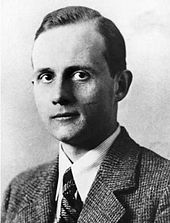
Among those expelled was the family unit of Sendel and Riva Grynszpan, Polish Jews who had emigrated to Germany in 1911 and settled in Hanover, Germany. At the trial of Adolf Eichmann in 1961, Sendel Grynszpan recounted the events of their displacement from Hanover on the dark of 27 October 1938: "Then they took united states of america in constabulary trucks, in prisoners' lorries, about twenty men in each truck, and they took united states of america to the railway station. The streets were full of people shouting: 'Juden Raus! Auf Nach Palästina!' " ("Jews out, out to Palestine!").[28] Their seventeen-year-old son Herschel was living in Paris with an uncle.[12] Herschel received a postcard from his family from the Smoothen border, describing the family's expulsion: "No ane told united states of america what was upwards, but nosotros realized this was going to be the terminate ... We haven't a penny. Could you lot transport us something?"[29] He received the postcard on 3 November 1938.
On the morning of Monday, 7 November 1938, he purchased a revolver and a box of bullets, so went to the High german embassy and asked to run across an embassy official. After he was taken to the office of Ernst vom Rath, Grynszpan fired five bullets at Vom Rath, two of which striking him in the belly. Vom Rath was a professional person diplomat with the Strange Office who expressed anti-Nazi sympathies, largely based on the Nazis' treatment of the Jews and was under Gestapo investigation for being politically unreliable.[30] Grynszpan made no endeavour to escape the French police and freely confessed to the shooting. In his pocket, he carried a postcard to his parents with the bulletin, "May God forgive me ... I must protestation so that the whole world hears my protest, and that I will practise." It is widely causeless that the assassination was politically motivated, but historian Hans-Jürgen Döscher says the shooting may have been the upshot of a homosexual dear affair gone incorrect. Grynszpan and vom Rath had become intimate afterwards they met in Le Boeuf sur le Toit, which was a pop meeting identify for gay men at the fourth dimension.[31]
The next day, the German regime retaliated, disallowment Jewish children from German land elementary schools, indefinitely suspending Jewish cultural activities, and putting a halt to the publication of Jewish newspapers and magazines, including the three national German Jewish newspapers. A newspaper in United kingdom described the concluding move, which cutting off the Jewish populace from their leaders, as "intended to disrupt the Jewish community and rob it of the last frail ties which hold it together."[xvi] Their rights as citizens had been stripped.[32] One of the offset legal measures issued was an order by Heinrich Himmler, commander of all German police, forbidding Jews to possess any weapons whatsoever and imposing a penalty of twenty years' confinement in a concentration camp upon every Jew plant in possession of a weapon hereafter.[33]
Pogrom
Death of Ernst vom Rath
Ernst vom Rath died of his wounds on 9 November 1938. Discussion of his death reached Hitler that evening while he was with several key members of the Nazi party at a dinner commemorating the 1923 Beer Hall Putsch. Later on intense discussions, Hitler left the associates abruptly without giving his usual address. Propaganda Government minister Joseph Goebbels delivered the voice communication, in his place, and said that "the Führer has decided that... demonstrations should not be prepared or organized by the political party, but insofar as they erupt spontaneously, they are non to be hampered."[34] The chief political party guess Walter Buch later on stated that the message was clear; with these words, Goebbels had allowable the party leaders to organize a pogrom.[35]
Some leading party officials disagreed with Goebbels' actions, fearing the diplomatic crisis information technology would provoke. Heinrich Himmler wrote, "I suppose that information technology is Goebbels's megalomania...and stupidity which is responsible for starting this operation now, in a particularly difficult diplomatic situation."[36] The Israeli historian Saul Friedländer believes that Goebbels had personal reasons for wanting to bring almost Kristallnacht. Goebbels had recently suffered humiliation for the ineffectiveness of his propaganda entrada during the Sudeten crisis, and was in some disgrace over an affair with a Czech actress, Lída Baarová. Goebbels needed a chance to meliorate his standing in the optics of Hitler. At 1:xx a.m. on 10 November 1938, Reinhard Heydrich sent an urgent secret telegram to the Sicherheitspolizei (Security Police; SiPo) and the Sturmabteilung (SA), containing instructions regarding the riots. This included guidelines for the protection of foreigners and non-Jewish businesses and property. Police were instructed not to interfere with the riots unless the guidelines were violated. Police were also instructed to seize Jewish archives from synagogues and community offices, and to arrest and detain "healthy male Jews, who are not besides old", for eventual transfer to (labor) concentration camps.[37]
Riots

Müller, in a message to SA and SS commanders, stated the "most extreme measures" were to be taken against Jewish people.[38] The SA and Hitler Youth shattered the windows of about 7,500 Jewish stores and businesses, hence the name Kristallnacht (Crystal Night), and looted their goods.[39] [six] Jewish homes were ransacked all throughout Germany. Although violence against Jews had not been explicitly condoned by the authorities, there were cases of Jews being beaten or assaulted. Following the violence, police departments recorded a large number of suicides and rapes.[6]
The rioters destroyed 267 synagogues throughout Germany, Austria, and the Sudetenland.[6] Over i,400 synagogues and prayer rooms,[40] many Jewish cemeteries, more than seven,000 Jewish shops, and 29 department stores were damaged, and in many cases destroyed. More than 30,000 Jewish men were arrested and imprisoned in Nazi concentration camps; primarily Dachau, Buchenwald, and Sachsenhausen.[41]
The synagogues, some centuries former, were also victims of considerable violence and vandalism, with the tactics the Stormtroops adept on these and other sacred sites described as "approaching the ghoulish" by the United States Consul in Leipzig. Tombstones were uprooted and graves violated. Fires were lit, and prayer books, scrolls, artwork and philosophy texts were thrown upon them, and precious buildings were either burned or smashed until unrecognizable. Eric Lucas recalls the destruction of the synagogue that a tiny Jewish community had constructed in a small hamlet only twelve years earlier:
"It did not take long before the first heavy grey stones came tumbling down, and the children of the village amused themselves as they flung stones into the many colored windows. When the offset rays of a cold and pale November sunday penetrated the heavy nighttime clouds, the lilliputian synagogue was simply a heap of stone, broken drinking glass and smashed-up woodwork."[42]
The Daily Telegraph correspondent, Hugh Greene, wrote of events in Berlin:
"Mob law ruled in Berlin throughout the afternoon and evening and hordes of hooligans indulged in an orgy of devastation. I have seen several anti-Jewish outbreaks in Germany during the last v years, merely never anything as nauseating as this. Racial hatred and hysteria seemed to have taken complete concord of otherwise decent people. I saw fashionably dressed women clapping their hands and screaming with glee, while respectable middle-course mothers held upwards their babies to see the 'fun'."[43]
Many Berliners were all the same deeply ashamed of the pogrom, and some took great personal risks to offering aid. The son of a US consular official heard the janitor of his cake cry: "They must accept emptied the insane asylums and penitentiaries to find people who'd do things similar that!"[44]
Tucson News Goggle box channel briefly reported on a 2008 remembrance meeting at a local Jewish congregation. According to eyewitness Esther Harris: "They ripped up the belongings, the books, knocked over furniture, shouted obscenities".[45] Historian Gerhard Weinberg is quoted as saying:
"Houses of worship burned down, vandalized, in every community in the country where people either participate or watch."[45]
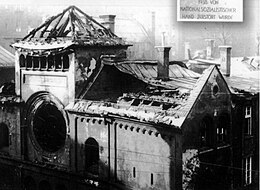
A ruined synagogue in Munich afterwards Kristallnacht
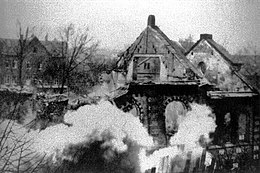
A ruined synagogue in Eisenach after Kristallnacht
Backwash
The former German Kaiser Wilhelm Ii commented "For the first time, I am ashamed to exist German."[46]
Göring, who was in favor of expropriating the property of the Jews rather than destroying it as had happened in the pogrom, direct complained to Sicherheitspolizei Chief Heydrich immediately subsequently the events: "I'd rather you had done in two-hundred Jews than destroy so many valuable assets!" ("Mir wäre lieber gewesen, ihr hättet 200 Juden erschlagen und hättet nicht solche Werte vernichtet!").[47] Göring met with other members of the Nazi leadership on 12 November to programme the next steps subsequently the riot, setting the stage for formal regime action. In the transcript of the meeting, Göring said,
I have received a letter written on the Führer'southward orders requesting that the Jewish question exist now, once and for all, coordinated and solved one way or some other... I should not want to leave any incertitude, gentlemen, equally to the aim of today's meeting. We take not come together merely to talk once more, just to make decisions, and I implore competent agencies to accept all measures for the elimination of the Jew from the German language economy, and to submit them to me.[48]
The persecution and economic impairment inflicted upon German Jews continued later on the pogrom, even every bit their places of business were ransacked. They were forced to pay Judenvermögensabgabe, a commonage fine or "atonement contribution" of one billion Reichsmarks for the murder of vom Rath (equivalent to four billion 2017 € or 7 billion in 2020 USD), which was levied by the compulsory conquering of 20% of all Jewish property by the state. 6 million Reichsmarks of insurance payments for property damage due to the Jewish community were instead paid to the Reich regime as "damages to the High german Nation". Jews were required to pay for the cost of all damages caused by the pogrom to their residences and businesses.[49] [50] [51]
The number of emigrating Jews surged, as those who were able to left the land. In the 10 months following Kristallnacht, more than 115,000 Jews emigrated from the Reich.[52] The majority went to other European countries, the U.South. and Mandatory Palestine, and at least 14,000 made it to Shanghai, China. Equally part of regime policy, the Nazis seized houses, shops, and other property the émigrés left behind. Many of the destroyed remains of Jewish belongings plundered during Kristallnacht were dumped near Brandenburg. In October 2008, this dumpsite was discovered by Yaron Svoray, an investigative journalist. The site, the size of iv football fields, contained an extensive assortment of personal and ceremonial items looted during the riots confronting Jewish property and places of worship on the dark of 9 November 1938. It is believed the appurtenances were brought by rail to the outskirts of the village and dumped on designated land. Among the items found were glass bottles engraved with the Star of David, mezuzot, painted window sills, and the armrests of chairs found in synagogues, in addition to an ornamental swastika.[53]
Responses to Kristallnacht
In Germany
The reaction of non-Jewish Germans to Kristallnacht was varied. Many spectators gathered on the scenes, well-nigh of them in silence. The local burn down departments confined themselves to prevent the flames from spreading to neighboring buildings. In Berlin, police Lieutenant Otto Bellgardt barred SA troopers from setting the New Synagogue on fire, earning his superior officer a verbal reprimand from the commissioner.[54]
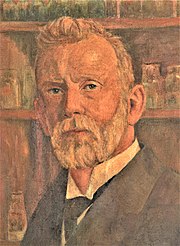
Portrait of Paul Ehrlich, damaged on Kristallnacht, so restored past a High german neighbor
The British historian Martin Gilbert believes that "many non-Jews resented the round-upwardly",[55] his opinion being supported by German witness Dr. Arthur Flehinger who recalls seeing "people crying while watching from backside their curtains".[56] Rolf Dessauers recalls how a neighbour came forward and restored a portrait of Paul Ehrlich that had been "slashed to ribbons" by the Sturmabteilung. "He wanted it to be known that not all Germans supported Kristallnacht."[57]
The extent of the damage done on Kristallnacht was so cracking that many Germans are said to have expressed their disapproval of it, and to have described it as senseless.[58]
In an article released for publication on the evening of 11 Nov, Goebbels ascribed the events of Kristallnacht to the "healthy instincts" of the German people. He went on to explicate: "The German people are anti-Semitic. Information technology has no want to take its rights restricted or to be provoked in the future past parasites of the Jewish race."[59] Less than 24 hours after Kristallnacht, Adolf Hitler made a one-60 minutes long speech in front end of a group of journalists where he completely ignored the contempo events on everyone's mind. Co-ordinate to Eugene Davidson the reason for this was that Hitler wished to avoid being direct continued to an event that he was aware that many of those present condemned, regardless of Goebbels'due south unconvincing explanation that Kristallnacht was caused by popular wrath.[60] Goebbels met the foreign press in the afternoon of eleven Nov and said that the burning of synagogues and damage to Jewish owned holding had been "spontaneous manifestations of indignation against the murder of Herr Vom Rath by the immature Jew Grynsban [sic]".[61]
In 1938, just subsequently Kristallnacht, the psychologist Michael Müller-Claudius interviewed 41 randomly selected Nazi Party members on their attitudes towards racial persecution. Of the interviewed political party-members 63% expressed extreme indignation against it, while only five% expressed approving of racial persecution, the rest being noncommittal.[62] A written report conducted in 1933 had so shown that 33% of Nazi Party members held no racial prejudice while 13% supported persecution. Sarah Ann Gordon sees two possible reasons for this difference. First, by 1938 large numbers of Germans had joined the Nazi Party for businesslike reasons rather than ideology thus diluting the percentage of rabid antisemites; 2nd, the Kristallnacht could accept caused political party members to reject antisemitism that had been acceptable to them in abstruse terms but which they could not support when they saw information technology concretely enacted.[63] During the events of Kristallnacht, several Gauleiter and deputy Gauleiters had refused orders to enact the Kristallnacht, and many leaders of the SA and of the Hitler Youth as well openly refused party orders, while expressing cloy.[64] Some Nazis helped Jews during the Kristallnacht.[64]

Later 1945 some synagogues were restored. This i in Berlin features a plaque, reading "Never forget", a common expression around Berlin
As information technology was aware that the German language public did not support the Kristallnacht, the propaganda ministry directed the German press to portray opponents of racial persecution as disloyal.[65] The press was besides nether orders to downplay the Kristallnacht, describing full general events at the local level only, with prohibition against depictions of private events.[66] In 1939 this was extended to a prohibition on reporting any anti-Jewish measures.[67]
The U.S. ambassador to Germany reported:
In view of this being a totalitarian state a surprising feature of the situation here is the intensity and scope among German language citizens of condemnation of the recent happenings against Jews.[68]
To the consternation of the Nazis, the Kristallnacht affected public stance counter to their desires, the peak of opposition against the Nazi racial policies was reached just then, when according to almost all accounts the vast majority of Germans rejected the violence perpetrated against the Jews.[69] Verbal complaints grew rapidly in numbers, and for example, the Düsseldorf branch of the Gestapo reported a abrupt turn down in anti-Semitic attitudes amid the population.[70]
There are many indications of Protestant and Cosmic disapproval of racial persecution; for instance, anti-Nazi Protestants adopted the Barmen Declaration in 1934, and the Catholic church building had already distributed pastoral letters critical of Nazi racial ideology, and the Nazi regime expected to run across organised resistance from it following Kristallnacht.[71] The Catholic leadership still, but equally the various Protestant churches, refrained from responding with organised activity.[71] While individual Catholics and Protestants took action, the churches as a whole chose silence publicly.[71] Nevertheless, individuals continued to show courage, for case, a parson paid the medical bills of a Jewish cancer patient and was sentenced to a large fine and several months in prison in 1941, Reformed Church pastor Paul Schneider placed a Nazi sympathizer under church discipline and he was subsequently sent to Buchenwald where he was murdered. A Catholic nun was sentenced to death in 1945 for helping Jews.[71] A Protestant parson spoke out in 1943 and was sent to Dachau concentration army camp where he died after a few days.[71]
Martin Sasse, Nazi Political party member and bishop of the Evangelical Lutheran Church in Thuringia, leading member of the Nazi German language Christians, one of the schismatic factions of German Protestantism, published a compendium of Martin Luther's writings soon after the Kristallnacht; Sasse "applauded the burning of the synagogues" and the coincidence of the mean solar day, writing in the introduction, "On ten November 1938, on Luther's altogether, the synagogues are burning in Germany." The German people, he urged, ought to heed these words "of the greatest anti-Semite of his time, the warner of his people against the Jews."[72] Diarmaid MacCulloch argued that Luther'due south 1543 pamphlet, On the Jews and Their Lies was a "design" for the Kristallnacht.[73]
Internationally
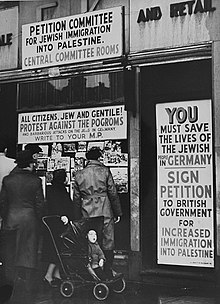
British Jews protestation against clearing restrictions to Palestine after Kristallnacht, November 1938
Kristallnacht sparked international outrage. According to Volker Ullrich, "...a line had been crossed: Germany had left the community of civilised nations."[74] Information technology discredited pro-Nazi movements in Europe and North America, leading to an eventual turn down in their support. Many newspapers condemned Kristallnacht, with some of them comparing information technology to the murderous pogroms incited by Royal Russia during the 1880s. The United States recalled its ambassador (but information technology did not interruption off diplomatic relations) while other governments severed diplomatic relations with Federal republic of germany in protest. The British government approved the Kindertransport plan for refugee children. As such, Kristallnacht also marked a turning point in relations between Nazi Germany and the rest of the world. The brutality of the pogrom, and the Nazi government's deliberate policy of encouraging the violence once it had begun, laid bare the repressive nature and widespread anti-Semitism entrenched in Frg. World opinion thus turned sharply against the Nazi authorities, with some politicians calling for state of war. On half dozen December 1938, William Cooper, an Aboriginal Australian, led a delegation of the Australian Aboriginal League on a march through Melbourne to the German language Consulate to deliver a petition which condemned the "cruel persecution of the Jewish people past the Nazi government of Germany". German officials refused to accept the tendered document.[75]
After the Kristallnacht, Salvador Allende, Gabriel González Videla, Marmaduke Grove, Florencio Durán and other members of the Congress of Chile sent a telegram to Adolf Hitler denouncing the persecution of Jews.[76] A more personal response, in 1939, was the oratorio A Child of Our Fourth dimension by the English language composer Michael Tippett.[77]
Kristallnacht every bit a turning point
Kristallnacht changed the nature of Nazi Germany'due south persecution of the Jews from economical, political, and social exclusion to concrete violence, including beatings, incarceration, and murder; the event is often referred to equally the first of the Holocaust. In this view, information technology is non but described every bit a pogrom, information technology is also described as a disquisitional phase inside a process in which each step becomes the seed of the next step.[78] An account cited that Hitler'southward dark-green low-cal for Kristallnacht was made with the belief that it would help him realize his appetite of getting rid of the Jews in Germany.[78] Prior to this big-calibration and organized violence against the Jews, the Nazi'south primary objective was to squirt them from Germany, leaving their wealth behind.[78] In the words of historian Max Rein in 1988, "Kristallnacht came...and everything was changed."[79]
While November 1938 predated the overt articulation of "the Last Solution", it foreshadowed the genocide to come up. Effectually the time of Kristallnacht, the SS newspaper Das Schwarze Korps called for a "devastation by swords and flames." At a conference on the twenty-four hour period later on the pogrom, Hermann Göring said: "The Jewish trouble will reach its solution if, in anytime soon, we will be drawn into war beyond our border—and so it is obvious that we will have to manage a final account with the Jews."[16]
Kristallnacht was also instrumental in changing global public stance. In the United States, for instance, it was this specific incident which came to symbolize Nazism and it was also the reason as to why the Nazis became associated with evil.[fourscore]
Modernistic references

Five decades afterward, ix November's clan with the anniversary of Kristallnacht was cited as the main reason as to why Schicksalstag, the day the Berlin Wall came down in 1989, was not turned into a new German national holiday; a different 24-hour interval was chosen (3 October 1990, German language reunification).[ citation needed ]
The avant-garde guitarist Gary Lucas's 1988 composition "Verklärte Kristallnacht", which juxtaposes what would become the Israeli national anthem x years after Kristallnacht, "Hatikvah", with phrases from the German national anthem "Germany Über Alles" among wild electronic shrieks and racket, is intended to exist a sonic representation of the horrors of Kristallnacht. It was premiered at the 1988 Berlin Jazz Festival and received rave reviews. (The championship is a reference to Arnold Schoenberg'due south 1899 work "Verklärte Nacht" that presaged his pioneering work on atonal music; Schoenberg was an Austrian Jew who would move to the United States to escape the Nazis).[81]
In 1989, Al Gore, then a senator from Tennessee and afterwards Vice President of the United States, wrote of an "ecological Kristallnacht" in The New York Times. He opined that events which were then taking place, such as deforestation and ozone depletion, prefigured a greater ecology catastrophe in the same manner that Kristallnacht prefigured the Holocaust.[82]
Kristallnacht was the inspiration for the 1993 album Kristallnacht by the composer John Zorn. The German power metallic band Masterplan'south debut album, Masterplan (2003), features an anti-Nazi song entitled "Crystal Night" as the fourth track. The High german band BAP published a song titled "Kristallnaach" in their Cologne dialect, dealing with the emotions engendered by the Kristallnacht.[83]
Kristallnacht was the inspiration for the 1988 composition Mayn Yngele by the composer Frederic Rzewski, of which he says: "I began writing this piece in November 1988, on the 50th anniversary of the Kristallnacht ... My slice is a reflection on that vanished role of Jewish tradition which so strongly colors, by its absence, the culture of our time".[84]
In 2014, the Wall Street Journal published a letter of the alphabet from billionaire Thomas Perkins that compared the "progressive war on the American one per centum" of wealthiest Americans and the Occupy motion's "demonization of the rich" to the Kristallnacht and antisemitism in Nazi Germany.[85] The alphabetic character was widely criticized and condemned in The Atlantic,[86] The Independent,[87] among bloggers, Twitter users, and "his own colleagues in Silicon Valley".[88] Perkins subsequently apologized for making the comparisons with Nazi Germany, but otherwise stood past his letter of the alphabet, maxim, "In the Nazi era it was racial demonization, now it'south form demonization."[88]
Kristallnacht has been referenced both explicitly and implicitly in countless cases of vandalism of Jewish property including the toppling of gravestones in a Jewish cemetery in suburban St. Louis, Missouri,[89] and the two 2017 vandalisms of the New England Holocaust Memorial, equally the memorial'south founder Steve Ross discusses in his volume, From Cleaved Glass: My Story of Finding Hope in Hitler's Expiry Camps to Inspire a New Generation.[90] The Sri Lankan Finance Minister Mangala Samaraweera also used the term to describe the violence in 2019 confronting Muslims past Sinhalese nationalists.[91]
Kristallnacht was publicly referenced on January 10, 2021 by the former Governor of California Arnold Schwarzenegger in a speech decrying the deportment of President Donald Trump and the assault he incited on the U.S. Capitol on January 6.[92] [93]
Encounter also
- Aktionsjuden
- Nathan Israel Department Store
- Spandau Synagogue
- Nov nine in German history
- A Child of Our Time
References
Informational notes
- ^ "Windows of shops endemic past Jews which were cleaved during a coordinated anti-Jewish sit-in in Berlin, known as Kristallnacht, on x November 1938. Nazi authorities turned a blind eye as SA stormtroopers and civilians destroyed storefronts with hammers, leaving the streets covered in pieces of smashed windows. Ninety-one Jews were killed, and 30,000 Jewish men were taken to concentration camps."[9]
Citations
- ^ Berenbaum, Michael (20 Dec 2018). "Kristallnacht". Encyclopædia Britannica. Encyclopædia Britannica, inc. Archived from the original on 22 July 2019. Retrieved ane July 2019.
Kristallnacht, (German: "Crystal Night"), besides called Night of Broken Drinking glass or November Pogroms
- ^ "The Nov Pogrom (Kristallnacht)". www.holocaust.org.united kingdom of great britain and northern ireland. The National Holocaust Center and Museum. Archived from the original on ane July 2019. Retrieved one July 2019.
The Nov Pogrom also has another proper noun, Kristallnacht, which ways "Crystal Nighttime". This night of Crystal refers to the Dark of Cleaved Glass...
- ^ "'German Mobs' Vengeance on Jews", The Daily Telegraph, 11 November 1938, cited in Gilbert, Martin (2006). Kristallnacht: Prelude to Destruction. New York: Harper Collins. p. 42. ISBN978-0060570835.
- ^ Schwab, Gerald (1990). The Day the Holocaust Began: The Odyssey of Herschel Grynszpan. Praeger. p. 14. ISBN9780275935764. Archived from the original on 6 June 2021. Retrieved 22 December 2016.
...vom Rath joined the NSDAP (Nazi party) on July 14, 1932, well before Hitler's rising to power
- ^ a b Gilbert 2006, pp. xiii–xiv
- ^ a b c d "Kristallnacht". www.ushmm.org. Archived from the original on 18 May 2018. Retrieved 19 May 2018.
- ^ Berenbaum, Michael & Kramer, Arnold (2005). The World Must Know. United States Holocaust Memorial Museum. p. 49.
- ^ Gilbert 2006, pp. 30–33
- ^ a b Taylor, Alan (19 June 2011). "Earth War Ii: Earlier the State of war" Archived vii Jan 2015 at the Wayback Car. The Atlantic.
- ^ "A Black Day for Germany", The Times, 11 November 1938, cited in Gilbert 2006, p. 41.
- ^ "KRISTALLNACHT: Amercement AND Decease". Holocaust Denial On Trial. Emory Academy. 2018. Archived from the original on 22 January 2020. Retrieved nine September 2019.
- ^ a b Multiple (1998). "Kristallnacht". The Hutchinson Encyclopedia. Hutchinson Encyclopedias (18th ed.). London: Helicon. p. 1,199. ISBN1-85833-951-0.
- ^ Goldstein, Joseph (1995). Jewish History in Modern Times. Sussex Academic Printing. pp. 43–44. ISBN 978-ane-898723-06-6.
- ^ Trueman, Chris. "Nazi Germany – dictatorship". Archived from the original on 6 March 2008. Retrieved 12 March 2008.
- ^ "Hitler's Enabling Act". Archived from the original on nine May 2008. Retrieved 12 March 2008.
- ^ a b c Gilbert 2006, p. 23
- ^ Cooper, R.1000. (1992). Refugee Scholars: Conversations with Tess Simpson. Leeds. p. 31.
- ^ "The Holocaust". Archived from the original on 1 February 2013. Retrieved 12 March 2008.
- ^ Manchester Guardian, 23 May 1936, cited in A.J. Sherman, Isle Refuge, Britain and the Refugees from the Third Reich, 1933–1939, (London, Elek Books Ltd, 1973), p. 112, too in The Evian Conference — Hitler'due south Green Lite for Genocide Archived 27 August 2013 at the Wayback Machine, past Annette Shaw
- ^ Johnson, Eric. The Nazi Terror: Gestapo, Jews and Ordinary Germans. Usa: Basic Books, 1999, p. 117.
- ^ Friedländer, Saul. Nazi Deutschland and The Jews, volume 1: The Years of Persecution 1933–1939, London: Phoenix, 1997, p. 270
- ^ a b Mommsen, Hans (12 December 1997). "Interview with Hans Mommsen" (PDF). Yad Vashem. Archived (PDF) from the original on 1 Feb 2013. Retrieved half-dozen Feb 2010.
- ^ Georg Landauer to Martin Rosenbluth, 8 February 1938, cited in Friedländer, loc. cit.
- ^ ""Polenaktion" und Pogrome 1938 – "Jetzt rast der Volkszorn. Laufen lassen"". Der Spiegel (in German). 29 Oct 2018. Archived from the original on thirty March 2019. Retrieved 9 Nov 2018.
- ^ Corb, Noam (2020). ""From Tears Come Rivers, from Rivers Come Oceans, from Oceans -a Flood": The Polenaktion, 1938-1939". Yad Vashem Studies. 48: 21–69.
- ^ "Expelled Jews' Nighttime Outlook". Newspaper article. London: The Times. 1 Nov 1938. Archived from the original on 23 May 2010. Retrieved 12 March 2008.
- ^ "Recollections of Rosalind Herzfeld," Jewish Chronicle, 28 September 1979, p. 80; cited in Gilbert, The Holocaust—The Jewish Tragedy, London: William Collins Sons & Co. Ltd, 1986.
- ^ Hannah Arendt, Eichmann in Jerusalem, p. 228.
- ^ German State Athenaeum, Potsdam, quoted in Rita Thalmann and Emmanuel Feinermann, Crystal night, ix–10 November 1938, pp. 33, 42.
- ^ William L. Shirer, The Rise And Autumn of the Third Reich, p. 430.
- ^ Did gay affair provide a catalyst for Kristallnacht? Archived 25 August 2013 at the Wayback Machine by Kate Connolly, The Guardian, thirty October 2001,
"On November vii, 1938, Herschel Grynszpan, a Jew, walked into the High german embassy in Paris and shot Ernst vom Rath, a High german diplomat. Nazi propagandists condemned the shooting as a terrorist attack to further the cause of the Jewish 'world revolution' and launched the serial of attacks known as Kristallnacht. Vom Rath and Grynszpan met in Le Boeuf sur le Toit bar, a pop haunt for gay men in the autumn of 1938 and became intimate." - ^ "Nazis Planning Revenge on Jews", News Relate, 9 November 1938
- ^ "Nazis Smash, Loot and Fire Jewish Shops and Temples Until Goebbels Calls Halt", New York Times, xi November 1938
- ^ Friedländer, op.cit., p. 113.
- ^ Walter Buch to Goring, 13.2.1939, Michaelis and Schraepler, Ursachen, Vol.12, p. 582 as cited in Friedländer, p. 271.
- ^ Graml, Anti-Semitism, p. thirteen cited in Friedländer, op.cit., p 272
- ^ "Heydrich'south cloak-and-dagger instructions regarding the riots in November 1938" Archived vii August 2017 at the Wayback Car, (Simon Wiesenthal Center)
- ^ Schnabel, Reimund (1957). Macht ohne Moral. Frankfurt: Roederberg Publishing. p. 78.
- ^ GermanNotes, "Kristallnacht - Night of Cleaved Glass". Archived from the original on nineteen April 2005. Retrieved vi March 2009. , retrieved 26 November 2007
- ^ "Dice "Kristallnacht"-Lüge - Dice Ereignisse vom nine./x. November 1938 | ZbE". www.zukunft-braucht-erinnerung.de. 26 October 2004. Archived from the original on 9 November 2018. Retrieved 19 March 2019.
- ^ "The displacement of Regensburg Jews to Dachau concentration campsite" Archived 6 October 2018 at the Wayback Machine (Yad Vashem Photo Archives 57659)
- ^ Lucas, Eric. "The sovereigns", Kibbutz Kfar Blum (Palestine), 1945, p. 171 cited in Gilbert, op.cit., p 67.
- ^ Carleton Greene, Hugh. Daily Telegraph, eleven Nov 1938 cited in "The Route to World War Two" Archived 30 September 2007 at the Wayback Machine, Western New England Higher.
- ^ "The Road to Earth War II" Archived xxx September 2007 at the Wayback Machine, Western New England College.[1]
- ^ a b "Kristallnacht Remembered". www.kold.com. Archived from the original on ten July 2009. Retrieved 17 May 2008.
- ^ Our German Cousins: Anglo-German Relations in the 19th and 20th Centuries (1974) past John Mander, p. 219
- ^ Döscher, Hans-Jürgen (2000). "Reichskristallnacht" – Die Novemberpogrome 1938 ("'Reichskristallnacht': The November pogroms of 1938"), Econ, 2000, ISBN 3-612-26753-1, p. 131
- ^ Conot, Robert. Justice at Nuremberg, New York, NY: Harper and Row, 1983, pp. 164–72.
- ^ ""JudenVermoegersabgabe" (The Center for Holocaust and Genocide Studies)". Archived from the original on 21 April 2006. Retrieved 4 May 2006.
- ^ Raul Hilberg. The Destruction of the European Jews, Tertiary Edition, (Yale Univ. Press, 2003, c1961), Ch.3.
- ^ Ullrich 2016, p. 678.
- ^ Jewish emigration from Frg Archived 12 May 2013 at the Wayback Car (USHMM)
- ^ Connolly, Kate (22 October 2008). "Kristallnacht remnants unearthed near Berlin". The Guardian. London. Archived from the original on iii September 2013. Retrieved vii May 2010.
- ^ Scheer, Regina (1993). "I'm Revier sixteen (In precinct No. xvi)". Die Hackeschen Höfe. Geschichte und Geschichten Feiner Lebenswelt in der Mitte Berlins (Gesellschaft Hackesche Höfe e.V. (ed.), pp. 78 ed.). Berlin: Argon. ISBN three-87024-254-X.
- ^ Gilbert, op. cit., p. 70
- ^ Dr. Arthur Flehinger, "Flames of Fury", Jewish Relate, 9 November 1979, p. 27, cited in Gilbert, loc. cit.
- ^ Rinde, Meir (2017). "A History of Violence". Distillations. Vol. 3, no. two. pp. 6–9. Archived from the original on 18 Apr 2018. Retrieved 18 Apr 2018.
- ^ "NEW CAMPAIGN AGAINST JEWS NAZI OUTBREAKS". eleven Nov 1938. p. i. Archived from the original on 6 June 2021. Retrieved 1 May 2017 – via Trove.
- ^ Daily Telegraph, 12 November 1938. Cited in Gilbert, Martin. Kristallnacht: Prelude to Destruction. Harper Collins, 2006, p. 142.
- ^ Eugene Davidson. The Unmaking of Adolf Hitler. Columbia: University of Missouri Printing, 1996. ISBN 978-0-8262-1045-6. p. 325
- ^ Guardian archive paradigm of Goebbels foreign printing conference: http://static.guim.co.united kingdom/sys-images/Guardian/Pix/pictures/2013/eleven/8/1383904706426/goebbels-001.jpg Archived 12 September 2015 at the Wayback Machine, retrieved 12 March 2017
- ^ Müller-Claudius, Michael (1948). Der Antisemitismus und das deutsche Verhangnis. Frankfurt: J. Knecht. pp. 76–77, 175–176.
- ^ Gordon 1984, pp. 263–264.
- ^ a b Gordon 1984, p. 266.
- ^ Gordon 1984, p. 159.
- ^ Gordon 1984, p. 156.
- ^ Gordon 1984, p. 157.
- ^ Gordon 1984, p. 176.
- ^ Gordon 1984, pp. 180, 207.
- ^ Gordon 1984, pp. 175–179, 215.
- ^ a b c d e Gordon 1984, pp. 251, 252, 258, 259.
- ^ Bernd Nellessen, "Die schweigende Kirche: Katholiken und Judenverfolgung", in Büttner (ed) Dice Deutschen und die Judenverfolgung im Dritten Reich, p. 265, cited in Daniel Goldhagen's Hitler'due south Willing Executioners (Vintage, 1997).
- ^ Diarmaid MacCulloch, Reformation: Europe'southward House Divided, 1490-1700. New York: Penguin Books Ltd, 2004, pp. 666–67.
- ^ Ullrich 2016, p. 676.
- ^ Miskin, Maayana (8 February 2010). "Yad Vashem to Honor Aborigine". Israel National News. Archived from the original on 14 March 2012. Retrieved 20 April 2012.
- ^ "Telegram protesting against the persecution of Jews in Germany" (PDF) (in Spanish). El Clarín de Chile's. Archived (PDF) from the original on 11 August 2012. Retrieved 19 Oct 2014.
- ^ Lewis, Geraint (May 2010). "Tippett, Sir Michael Kemp". Oxford Dictionary of National Biography (online ed.). Oxford Academy Press. doi:ten.1093/ref:odnb/69100. Retrieved 29 April 2012. (Subscription or Uk public library membership required.) (subscription required)
- ^ a b c Steinweis, Alan Eastward. (2009). Kristallnacht 1938. Cambridge, MA: Harvard University Press. pp. 3. ISBN9780674036239.
- ^ Krefeld, Stadt (1988). Ehemalige Krefelder Juden berichten uber ihre Erlebnisse in der sogenannten Reichskristallnacht. Krefelder Juden in Amerika. Vol. 3. Cited in Johnson, Eric. Krefeld Stadt Archiv: Basic Books. p. 117.
- ^ Alexander, Jeffrey (2009). Remembering the Holocaust: A Debate. Oxford: Oxford University Press. p. 12. ISBN9780195326222.
- ^ Seth Rogovoy (20 April 2001). "Gary Lucas: Activeness guitarist". Berkshire Hawkeye. Archived from the original on 9 May 2008. Retrieved xx May 2008.
A knowing reference to Arnold Schoenberg'south "Verklarte Nacht", the piece ironically juxtaposed the Israeli national canticle, "Hatikvah," with phrases from "Deutschland Uber Alles," amongst wild electronic shrieks and dissonance. The next day the papers ran a picture of Lucas with the triumphant headline, "It is Lucas!"
- ^ Abert Gore (nineteen March 1989). "An Ecological Kristallnacht. Listen". The New York Times. Archived from the original on three April 2019. Retrieved 25 Feb 2019.
Scientists now predict our electric current course volition raise world temperatures five degrees Celsius in our lifetimes
- ^ "BAP Songtexte (German language)". Archived from the original on 23 May 2008. Retrieved 16 May 2008.
- ^ "Mayn Yingele (Rzewski, Frederic)". Archived from the original on iv February 2016. Retrieved 25 January 2016.
- ^ Perkins, Tom (24 January 2014). "Progressive Kristallnacht Coming?". Wall Street Journal. Archived from the original on 26 October 2014. Retrieved 25 January 2014.
- ^ Weissman, Jordan. "Millionaire Apologizes for Comparison Progressives to Nazis, Says His Watch Is Worth a '6-Pack of Rolexes'". The Atlantic. Archived from the original on 26 June 2020. Retrieved 28 Jan 2014.
- ^ Williams, Rob (26 January 2014). "Tom Perkins: Billionaire venture capitalist ridiculed after writing letter comparison the treatment of rich Americans to the Holocaust". The Independent. Archived from the original on 25 September 2015. Retrieved 27 January 2014.
- ^ a b Ross, Philip (27 January 2014). "Tom Perkins Responds To Nazi Germany And 1 Pct Criticism, Says Kristallnacht Was 'Terrible Give-and-take To Have Chosen'". International Business Times. Archived from the original on 26 November 2015. Retrieved 29 January 2014.
- ^ "St. Louis Jewish cemetery rededicated afterwards gravestones toppled past vandals - Diaspora - Jerusalem Postal service". www.jpost.com. Archived from the original on 22 August 2018. Retrieved 21 August 2018.
- ^ Reporter, Adam Vaccaro-. "Holocaust Memorial in Boston damaged for 2nd time this summertime - The Boston Globe". BostonGlobe.com. Archived from the original on 26 June 2018. Retrieved 21 Baronial 2018.
- ^ "Finance minister slams Judenboykott, Kristallnacht re-enaction against Muslims in Sri Lanka". www.economynext.com. 24 May 2019. Retrieved 10 June 2019.
- ^ Barr, Jeremy (January ten, 2021) "Schwarzenegger compares Capitol mob violence to Kristallnacht destruction past Nazis in viral video" Archived 11 January 2021 at the Wayback Machine The Washington Post
- ^ Pengellly, Martin (January 10, 2021) "Schwarzenegger rebukes Trump and compares Capitol riot to Kristallnacht" Archived 11 Jan 2021 at the Wayback Car The Guardian
Bibliography
- Gordon, Sarah Ann (1984). Hitler, Germans, and the Jewish Question . Princeton, New Jersey: Princeton University Press. ISBN0-691-10162-0.
- Ullrich, Volker (2016). Hitler: Ascent 1889-1939. Translated past Jefferson Chase. New York: Vintage. ISBN978-1-101-87205-5.
Further reading
-
- Books in English language
- Friedlander, Saul (1998). Nazi Frg and the Jews: Volume 1: The Years of Persecution 1933–1939. New York, NY: Perennial. ISBN0-06-092878-6.
- Gruner, Wolf; Ross, Steven Joseph, eds. (2019). New Perspectives on Kristallnacht. Purdue University Press. ISBN978-1-61249-616-0.
- Mayer, Kurt (2009). My Personal Brush with History. Tacoma: Confluence Books. ISBN978-0-578-03911-four.
- Steinweis, Alan Due east. (2009). Kristallnacht 1938. Harvard University Press. ISBN978-0-674-03623-9.
-
- Books in German
- Arntz, Hans-Dieter (2008) "Reichskristallnacht". Der Novemberpogrom 1938 auf dem Lande – Gerichtsakten und Zeugenaussagen am Beispiel der Eifel und Voreifel. (in German language) Aachen: Helios-Verlag. ISBN 978-3-938208-69-4
- Döscher, Hans-Jürgen (1988). Reichskristallnacht: Die Novemberpogrome 1938 (in German language). Ullstein. ISBN978-3-550-07495-0.
- Faludi, Christian (2013) Die "Juni-Aktion" 1938. Eine Dokumentation zur Radikalisierung der Judenverfolgung. (in German) Frankfurt a. K./New York: Campus. ISBN 978-3-593-39823-5
- Korb, Alexander (2007). Reaktionen der deutschen Bevölkerung auf dice Novemberpogrome im Spiegel amtlicher Berichte (in German). Saarbrücken: VDM Verlag. ISBN978-three-8364-4823-9.
- Lauber, Heinz (1981). Judenpogrom: "Reichskristallnacht" November 1938 in Grossdeutschland : Daten, Fakten, Dokumente, Quellentexte, Thesen und Bewertungen (Aktuelles Taschenbuch) (in German language). Bleicher. ISBN3-88350-005-iv.
- Pätzold, Kurt; Runge, Irene (1988). Kristallnacht: Zum Pogrom 1938 (Geschichte) (in German language). Köln: Pahl-Rugenstein. ISBN3-7609-1233-viii.
- Pehle, Walter H. (1988). Der Judenpogrom 1938: Von der "Reichskristallnacht" zum Völkermord (in High german). Frankfurt am Master: Fischer Taschenbuch Verlag. ISBN3-596-24386-half-dozen.
- Richter, Hans Peter (1970) Friedrich (in German) Puffin Books
- Schultheis, Herbert (1985). Die Reichskristallnacht in Deutschland nach Augenzeugenberichten (Bad Neustadter Beiträge zur Geschichte und Heimatkunde Frankens) (in German). Bad Neustadt a. d. Saale: Rotter Druck und Verlag. ISBNthree-9800482-3-3.
External links
- Voices on Antisemitism Interview with Susan Warsinger from the U.s. Holocaust Memorial Museum
- "Interview with Miriam Ron, Witness to the Events of Kristallnacht". The International Schoolhouse for Holocaust Studies. Archived from the original on 15 May 2017. -- "At vii:00 in the morn I was a student, and at 5:00, I was a criminal"
- Allida Black; June Hopkins; et al. (2003). "The Eleanor Roosevelt Papers – Kristallnacht". Instruction Eleanor Roosevelt; Eleanor Roosevelt National Celebrated Site, Hyde Park, New York. U.s. National Park Service archive (nps.gov). Retrieved xx May 2008.
- "Kristallnacht: A Nationwide Pogrom, November ix–x, 1938". Holocaust Encyclopedia. US Holocaust Memorial Museum. Retrieved 20 May 2008.
- "Kristallnacht: The Nov 1938 Pogroms". Online exhibitions, special topics. US Holocaust Memorial Museum. Archived from the original on 17 May 2008. Retrieved 20 May 2008.
- Yad Vashem (2004). "Kristallnacht". Yad Vashem'south Photo Archives. The Holocaust Martyrs' and Heroes' Remembrance Potency. Archived from the original on ix March 2005. Retrieved 21 May 2008.
Source: https://en.wikipedia.org/wiki/Kristallnacht
0 Response to "Wahat Was the First Night of Violence Agains Jews Called"
Postar um comentário